The Human Foundation

A Documentary Archive of Doha's Migrant Workforce (2012–2015)
Chapter I

The Shadow of West Bay

Before the 2022 World Cup brought global scrutiny to Qatar's kafala labor system, the foundations of Doha's futuristic skyline were already being laid. The multi-billion dollar developments in West Bay, such as the Qatar Petroleum District, required an immense, synchronized human effort. Operating in grueling 10-to-12-hour shifts, a massive expatriate workforce—rigidly organized by a color-coded hierarchy of hard hats and safety gear—fueled the rapid expansion of the modern city. This chapter documents the daily, grinding reality of these active megaprojects, highlighting the stark visual and physical contrasts between the ultra-wealthy, aspirational environment being built and the harsh, restrictive reality of the marginalized men building it.
The Toolbox Talk

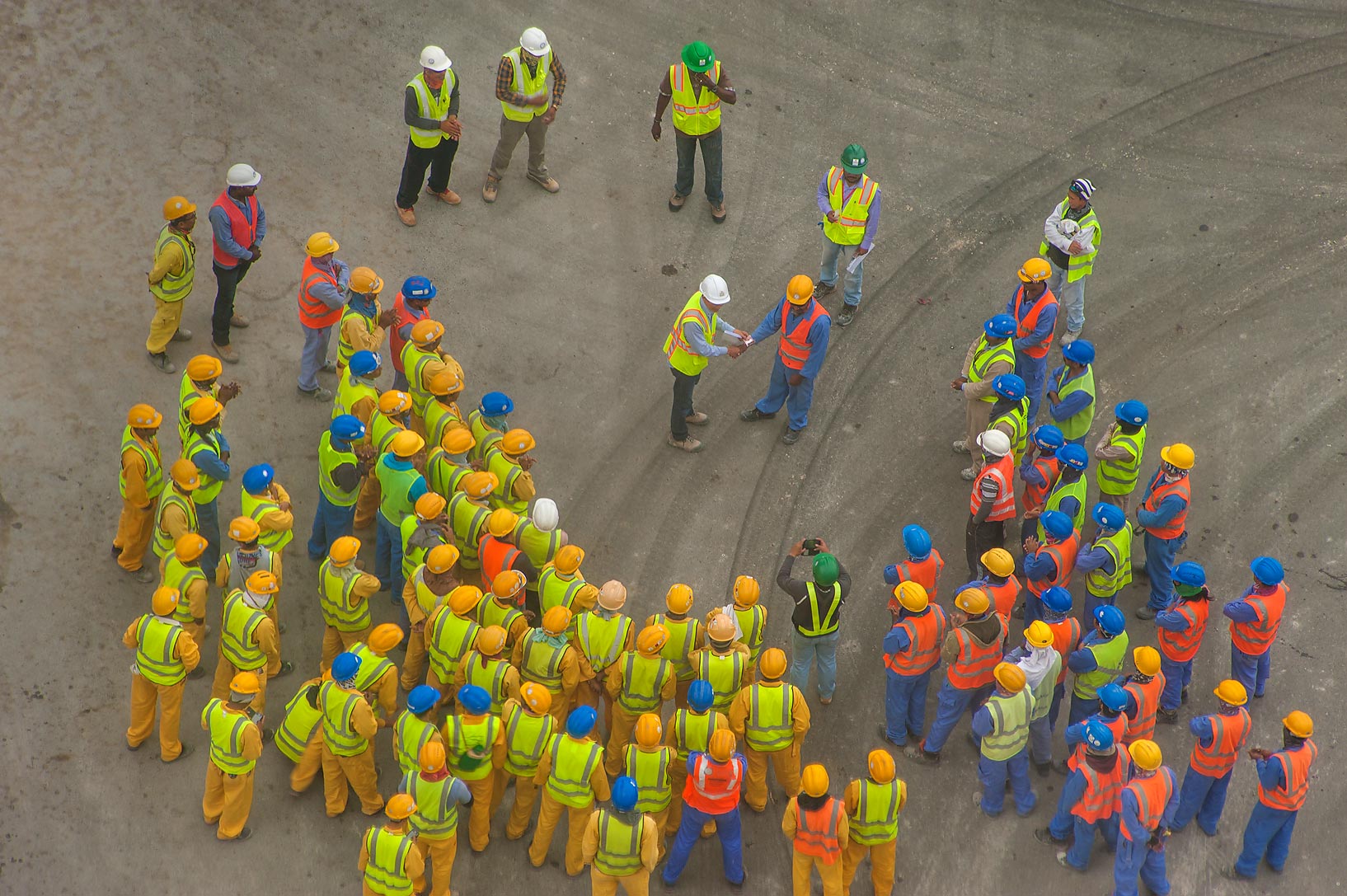
Viewed from above in the early morning light, dozens of workers gather in a loose circle for a morning safety briefing. The rigid hierarchy of the site is visually reinforced by their hard hats: the outer circle is dominated by the yellow and blue helmets of general laborers, while the men in the center wear the white and green hats of managers and safety officers. In the center of the ring, a manager distributes what appears to be a 'worker of the month' certificate, a fleeting, structured moment of recognition before the start of a grueling shift.
The Monarch and the Laborers

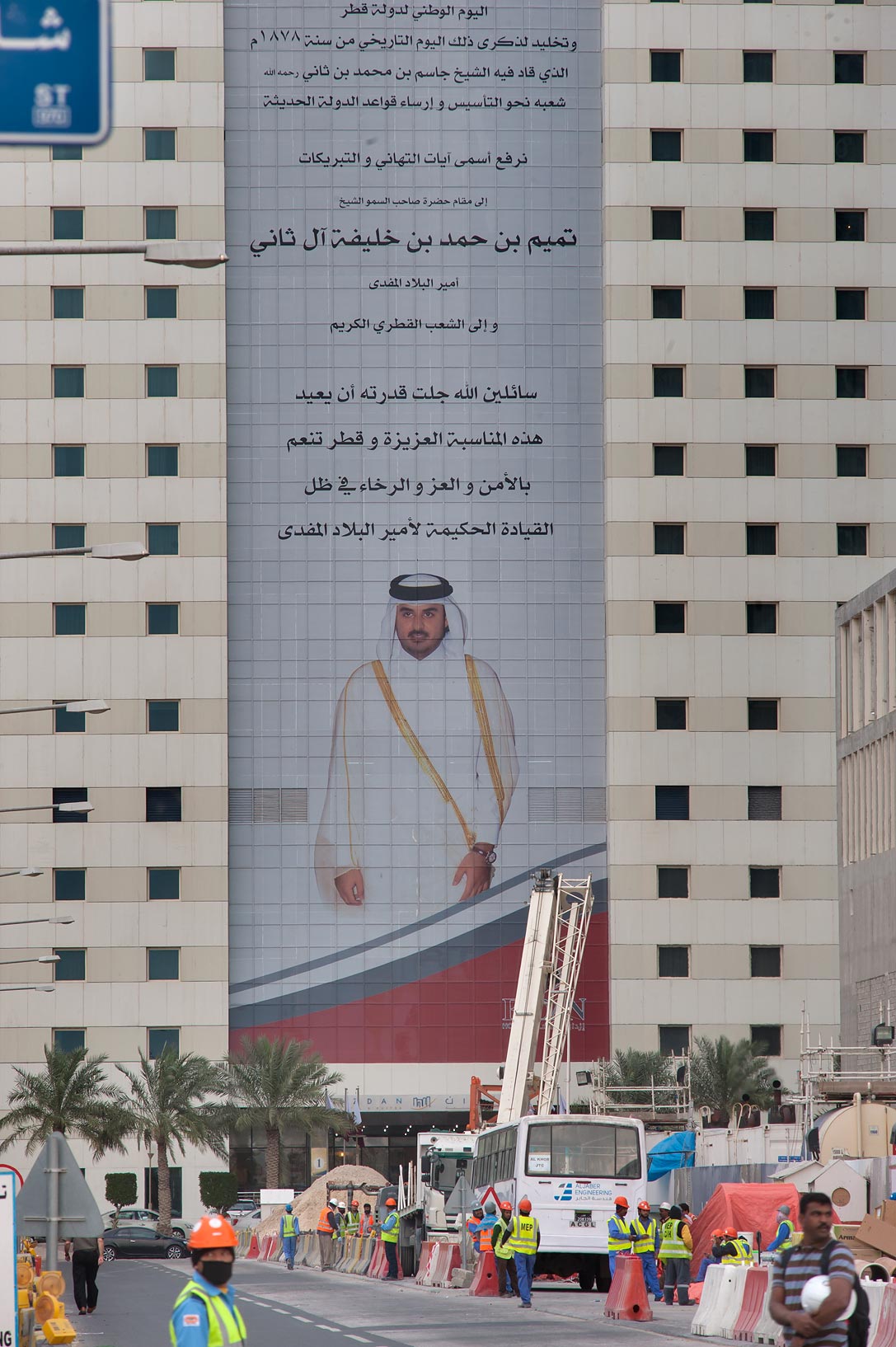
At the edge of a bustling construction zone, migrant laborers are dwarfed by a colossal portrait of Qatar's Emir spanning dozens of stories down the facade of the Ezdan Tower. Below this monumental display of wealth and state sovereignty, the reality of the city's creation unfolds amid the clutter of concrete barricades and heavy-duty trucks. The pristine, aspirational image of the ruling monarch projects a unified vision from above, while the foreign laborers building that vision are relegated to the thoroughly utilitarian reality of the street below.
The Theatrical Backdrop

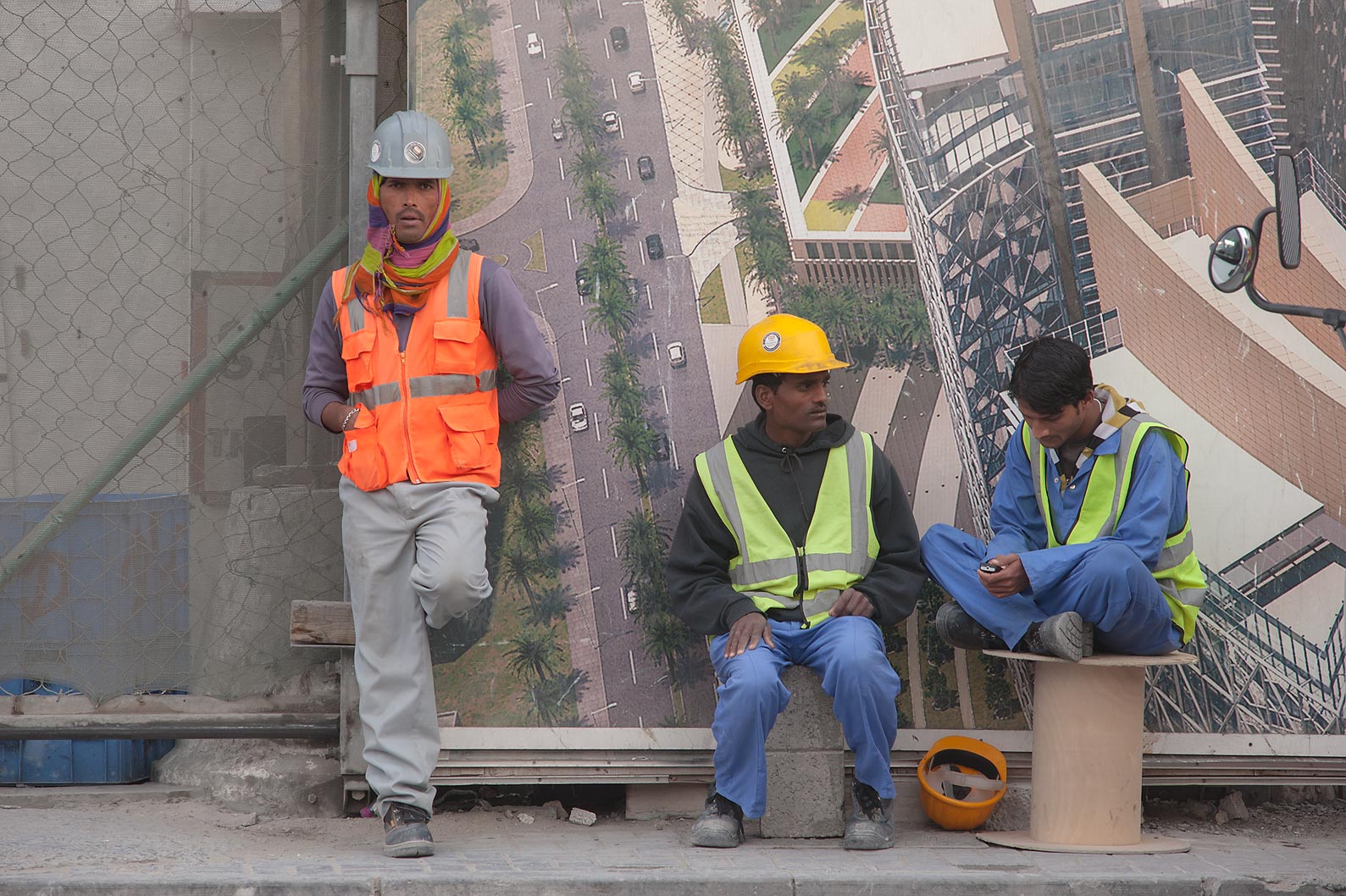
Three migrant workers take a meager rest on the dusty pavement beneath a towering advertising hoarding. The sheer scale of the billboard—depicting manicured, palm-lined avenues—provides a stark, almost theatrical contrast to the gritty environment at ground level. Exhibiting a palpable sense of fatigue, one worker leans heavily against a support beam, while another has removed his bright yellow hard hat entirely, retreating into the small, private distraction of his mobile phone as they wait for company transport.
Makeshift Amenities

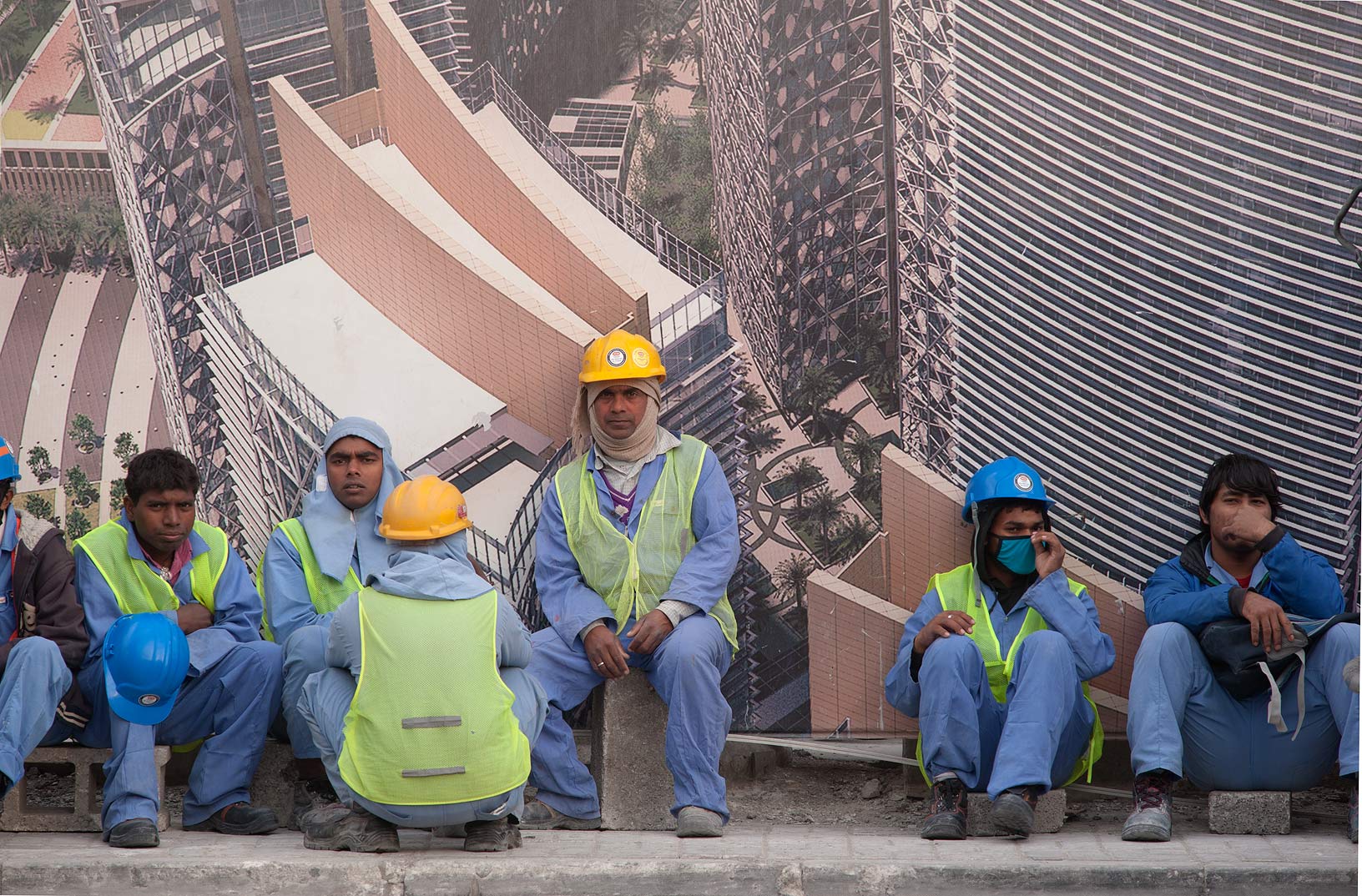
Further along the perimeter, a larger crew rests uncomfortably on cinderblocks and scattered concrete. The painted plywood fence behind them displays the architectural renderings of the Qatar Petroleum buildings, but the immediate reality is one of pervasive construction dust. To protect themselves from the harsh elements, several men have pulled the hoods of their coveralls over their heads or wrapped scarves tightly beneath their helmets, while one worker wears a blue surgical mask. Their heavy, dust-caked boots rest on the uneven pavement, anchoring a scene completely devoid of dedicated break zones.
The Golden Hour Exhaustion

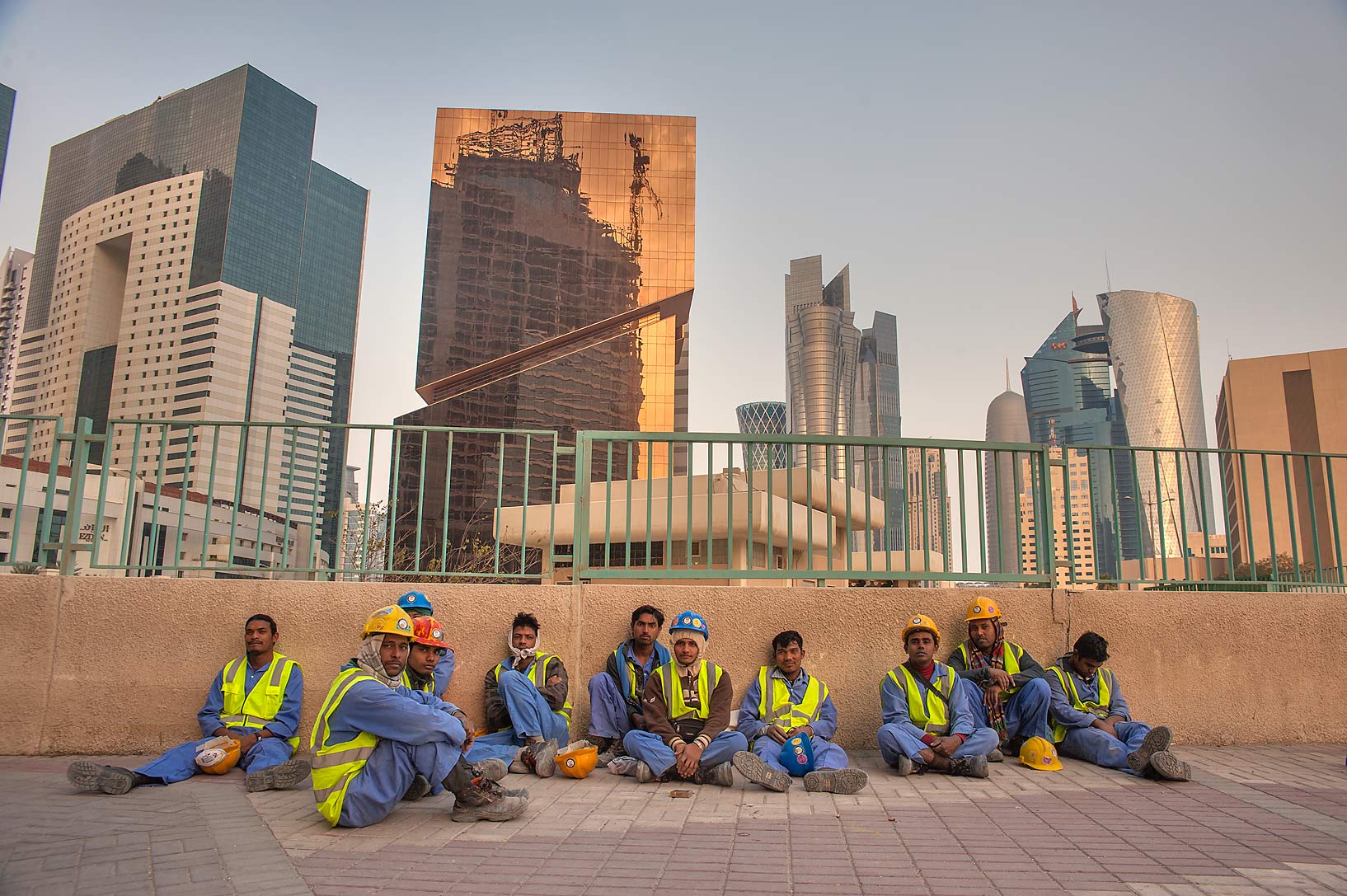
Bathed in golden hour sunlight, a long row of exhausted laborers sits huddled against a low concrete wall, physically dwarfed by the towering glass skyline they are constructing. The smooth, golden reflection of an unfinished skyscraper in the facade behind them forms a sharp, almost cinematic contrast to the dust-stained blue coveralls and slumped postures of the men. Lacking any basic amenities, the workers sit shoulder-to-shoulder on the pavement, a vibrant human element anchoring a landscape dominated by imposing, impersonal geometry.
The Tiffin Carriers

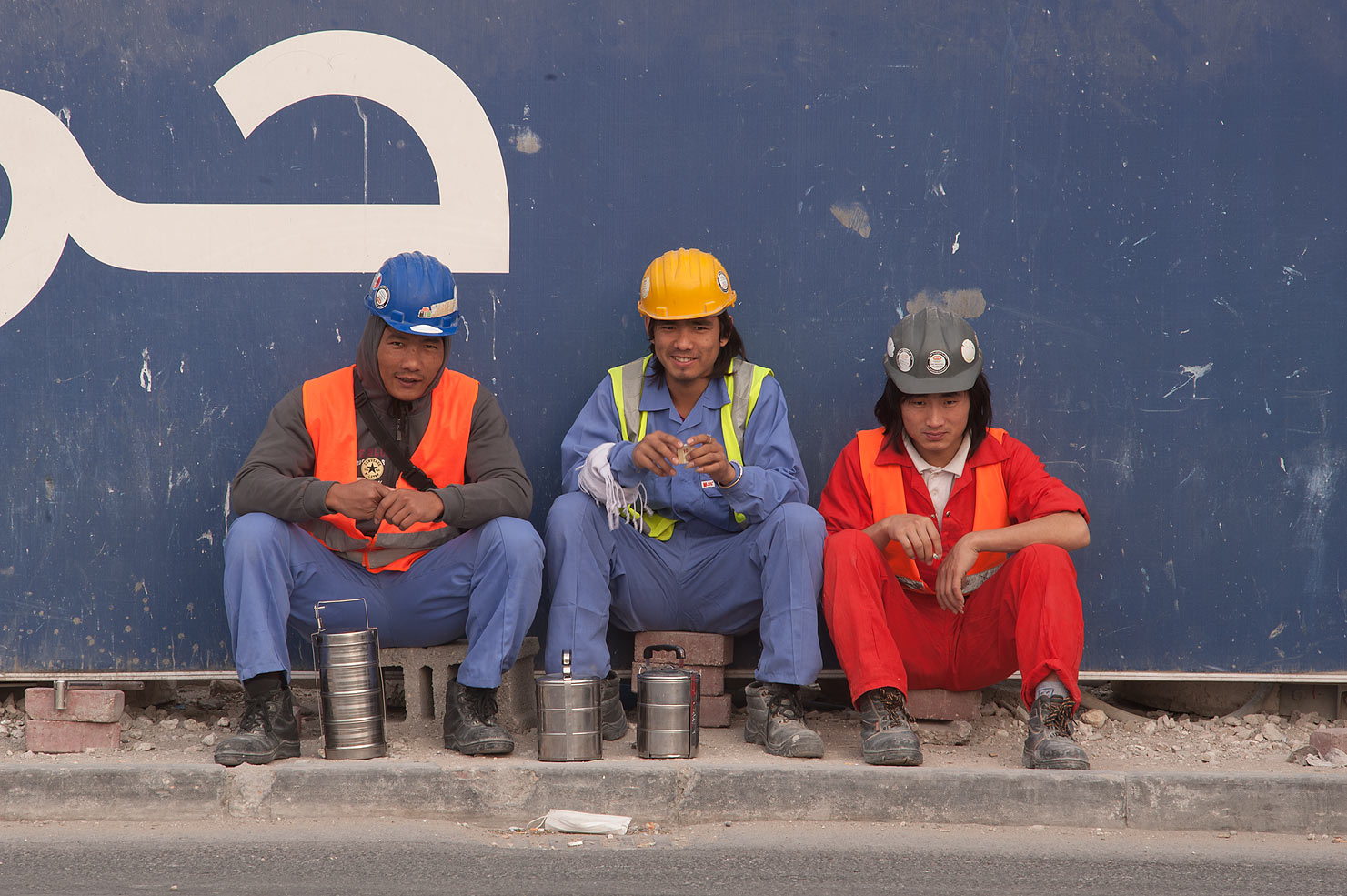
Taking a brief respite on makeshift stools of cinderblocks, three laborers rest beside their stainless-steel, multi-tiered tiffin carriers. These traditional South Asian lunch boxes highlight a daily logistical reality: because on-site catering was practically non-existent, the men relied on meals cooked hours earlier in distant labor camps. Despite the grueling nature of their environment, two of the men look directly at the camera with gentle smiles, offering a fleeting glimpse of humanity amid the heavy industrial machinery.
The Color-Coded Barrier

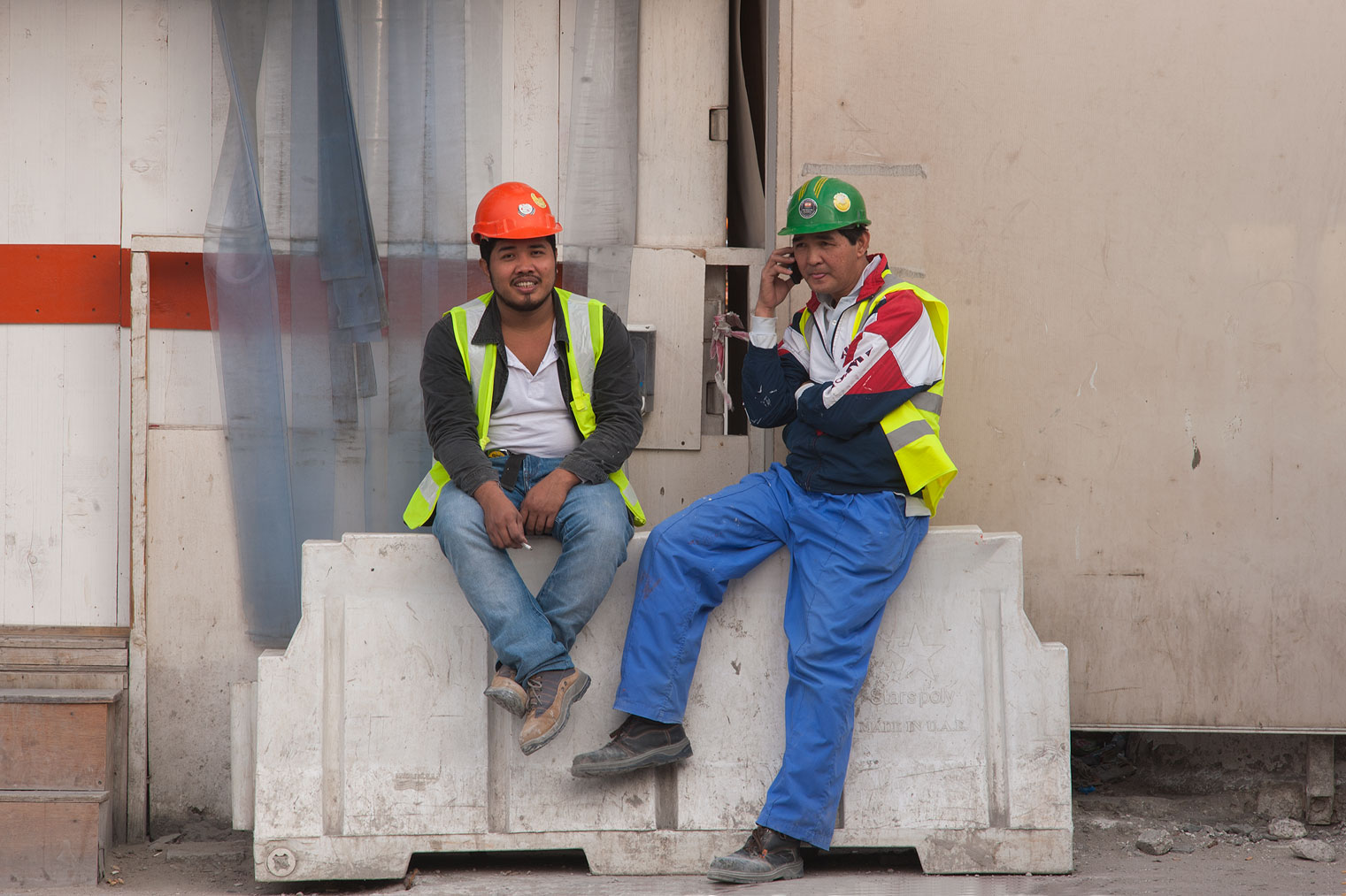
Two men share a quiet, companionable moment perched on a heavy plastic road barrier. The differences in their attire illustrate the class system prevalent on the sites: the man on the left wears the bright orange hat and scuffed boots of a general tradesman, while the man on the right wears the green hat, clean sport jacket, and pristine trousers of a supervisor. Despite the difference in their apparent ranks, their shared rest on the concrete barrier highlights that all men in this system are ultimately bound by the same harsh environmental realities.
The 17:00 Bottleneck

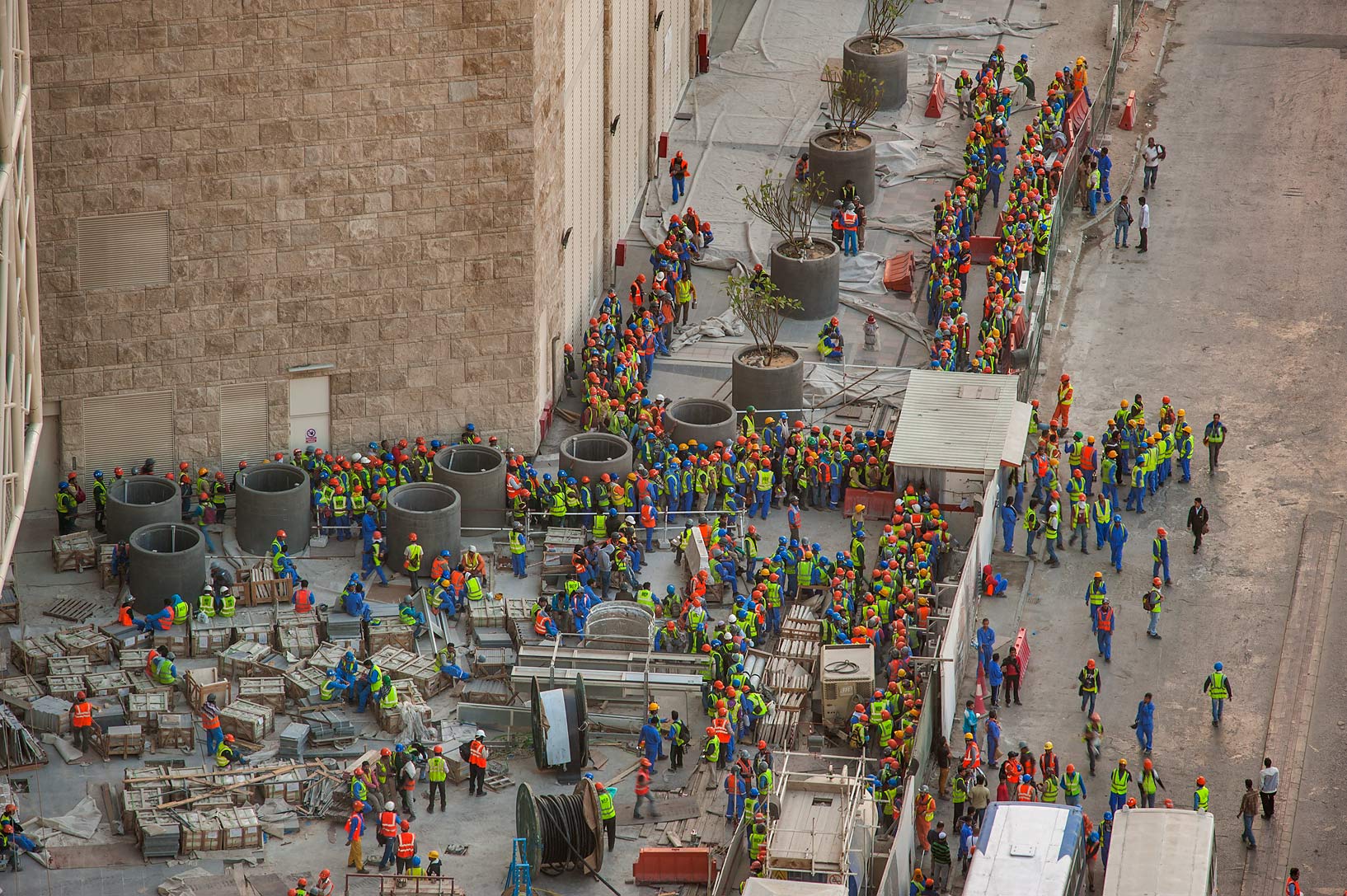
As the workday concludes, hundreds of laborers converge at the narrow perimeter exit of the Qatar Petroleum District site, creating a massive, sprawling bottleneck. The congestion is caused by a small access-control turnstile near the street, forcing the exhausted men to wait in a tightly packed queue. Unable to exit quickly, dozens of men improvise dangerous rest spots by climbing inside massive grey concrete utility rings or perching on giant wooden spools of heavy electrical cabling.
The Color of Labor

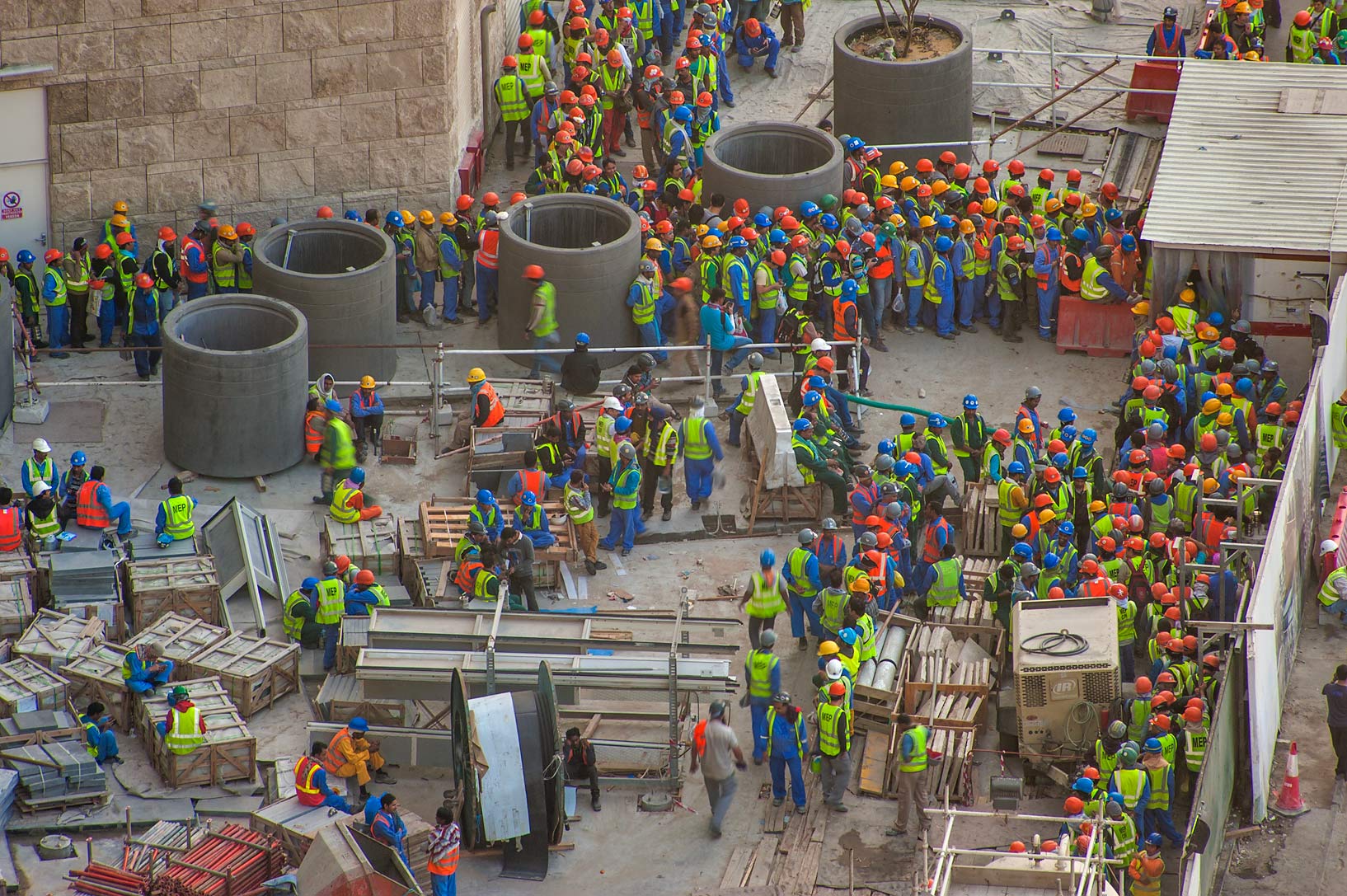
Captured from a high vantage point, the dense crowd waiting to exit the staging area is awash in the vivid, mandatory safety colors of the construction industry. The vast majority wear heavy blue overalls paired with bright neon green, yellow, or orange safety vests and matching hard hats. This routine daily exodus underscores the systemic challenges the men faced: after completing grueling shifts in harsh conditions, they endured significant delays simply trying to exit the site, only to begin the long wait for the transport buses back to their distant camps.
Chapter II

The Erasure of Msheireb

As the Qatari government moved forward with its visionary $5.5 billion master plan to construct the luxury Msheireb Downtown smart-city, it systematically purchased and cleared the historic neighborhoods of central Doha. Fully aware that the area was slated for the bulldozer, property owners ceased all basic maintenance on the remaining buildings. Consequently, thousands of low-wage migrant workers were left to inhabit severely degraded, overcrowded slums, effectively living inside active demolition zones. This chapter captures a transitional era of profound neglect and displacement, documenting the exact moment when the marginalized reality of the expatriate workforce collided with the glittering, relentless ambition of Qatar's urban renewal.

The Encroaching Skyline

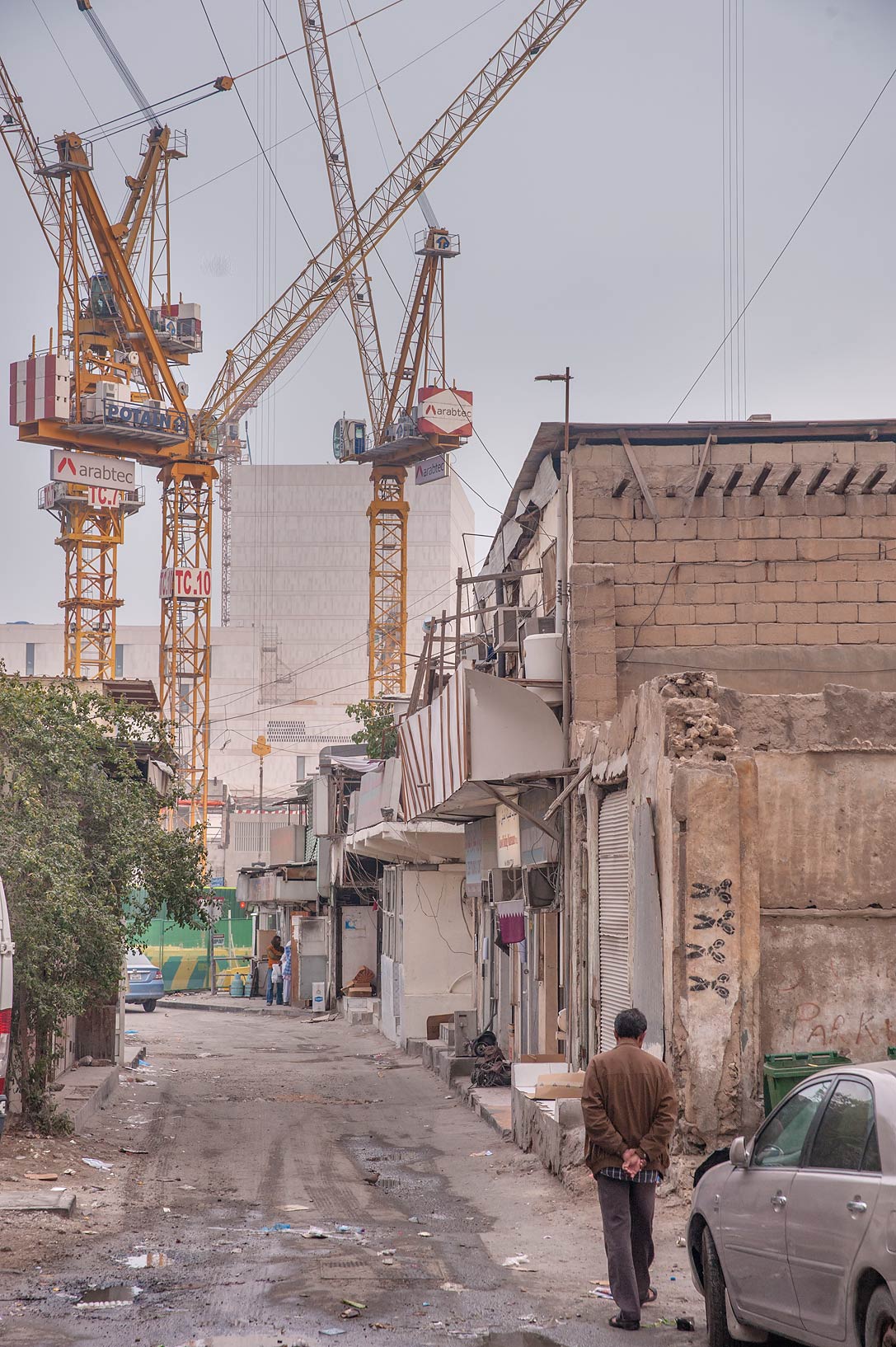
A stark juxtaposition frames the impending erasure of the historic district. In the foreground, a lone man navigates a narrow, unpaved alleyway flanked by dilapidated, single-story tenements made of mud-rendered stone and corrugated metal. Looming ominously directly behind these impoverished structures is the massive scale of the new Msheireb Downtown project. Two towering yellow construction cranes actively assemble the sleek, monolithic buildings that appear to physically bear down on the crumbling neighborhood below.

Life in the Ruins

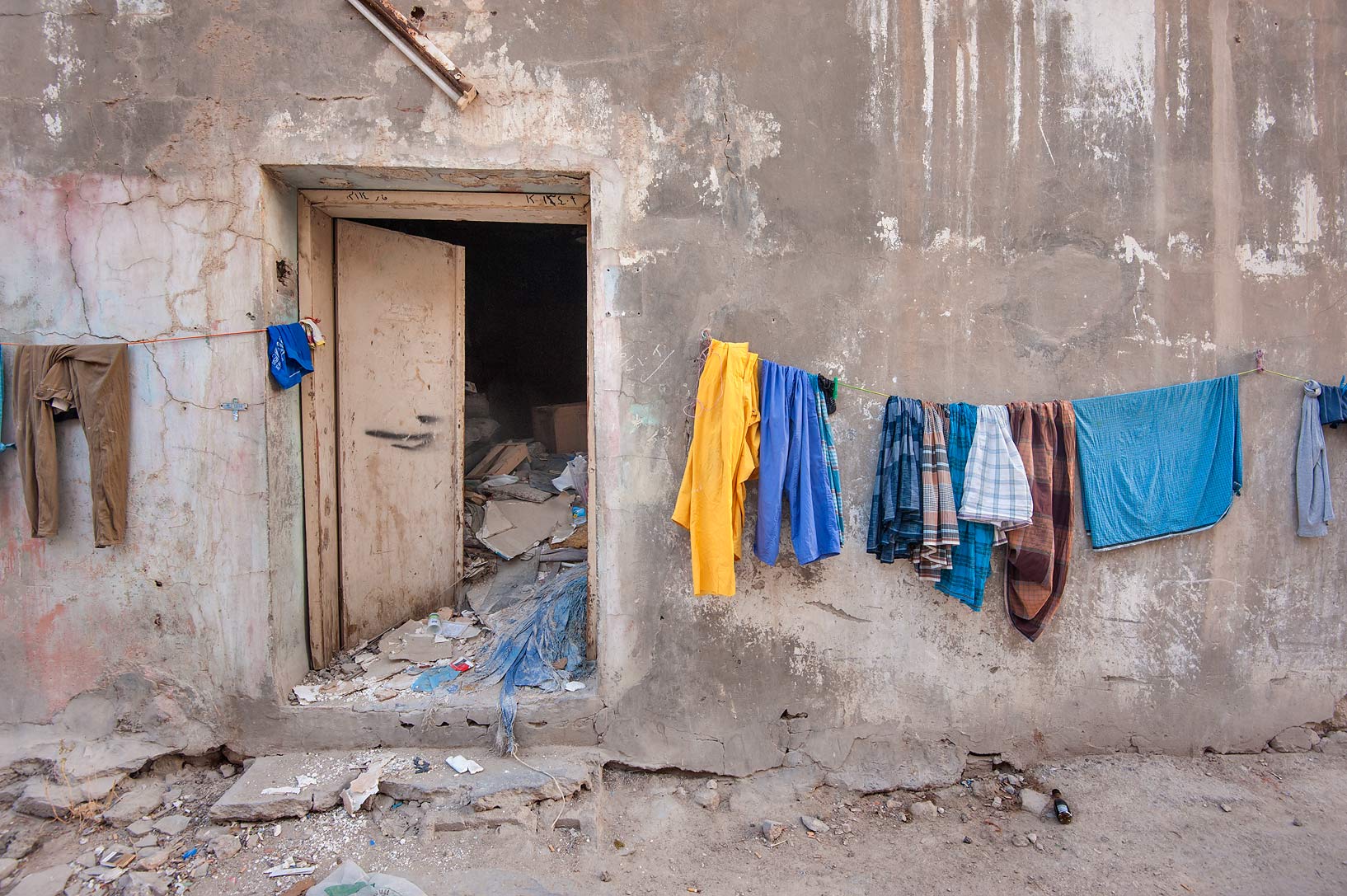
The facade of a dilapidated building on Al Jassasiya Street offers a bleak look into the housing conditions endured before the mass demolition. A heavy wooden door stands ajar, revealing an interior covered in rubble, torn plastic sheeting, and broken concrete. Despite this level of structural ruin, the exterior wall tells a story of desperate, ongoing habitation: a makeshift clothesline is strung across the cracking plaster, heavily laden with freshly washed work uniforms and casual trousers.

The Faded Affection

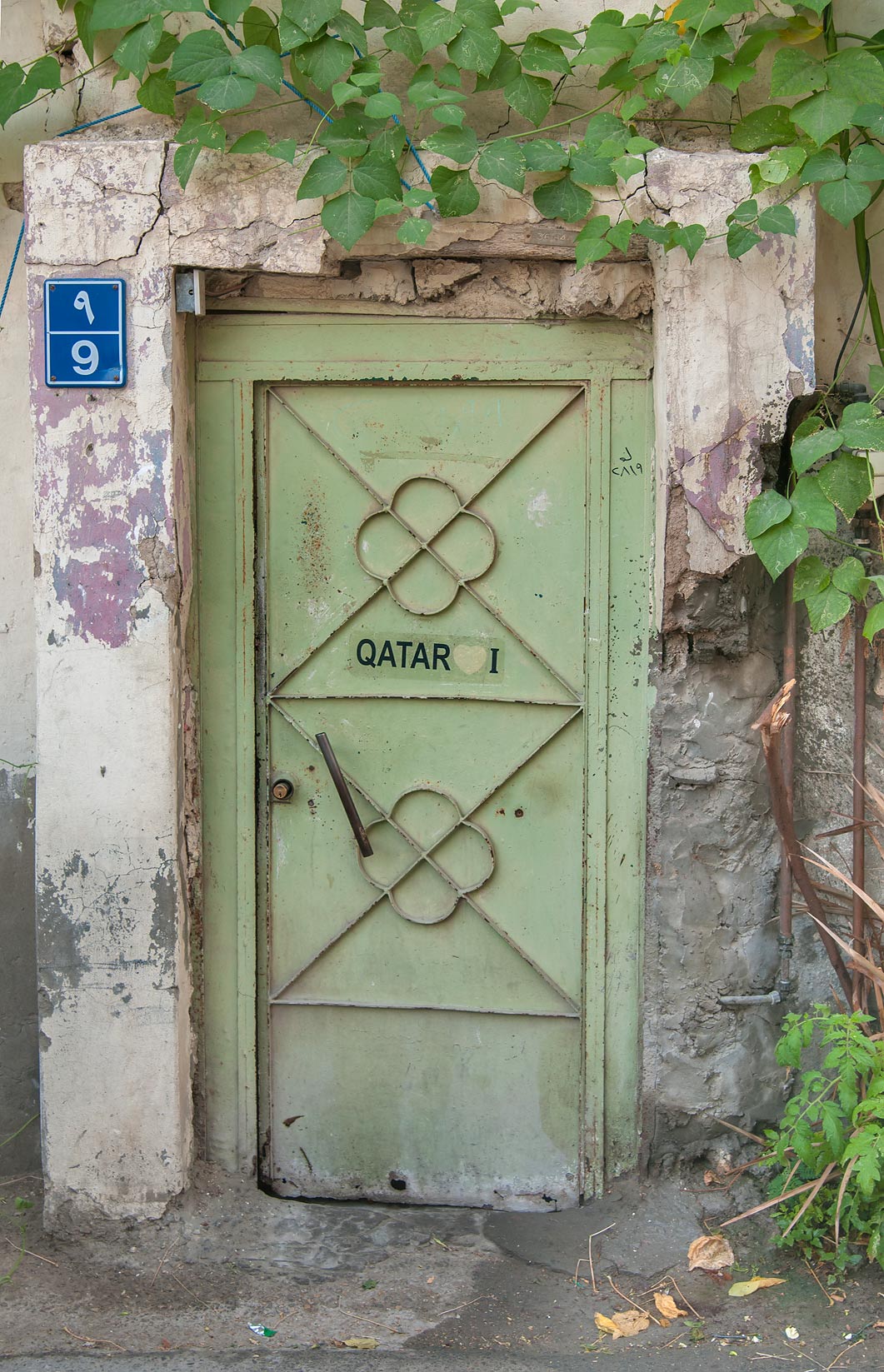
Set into a crumbling plaster wall, a traditional Qatari iron door provides a rare glimpse of personal expression amid the widespread decay. In the center panel, someone has carefully applied black lettering and a small heart sticker to read 'QATAR ♥ I,' an inverted declaration of affection. This small, humanizing detail—along with the green bean vines and a stubborn tomato plant growing from the cracked pavement—stands in stark contrast to the profound neglect of a neighborhood preparing to displace its residents.

The Displaced

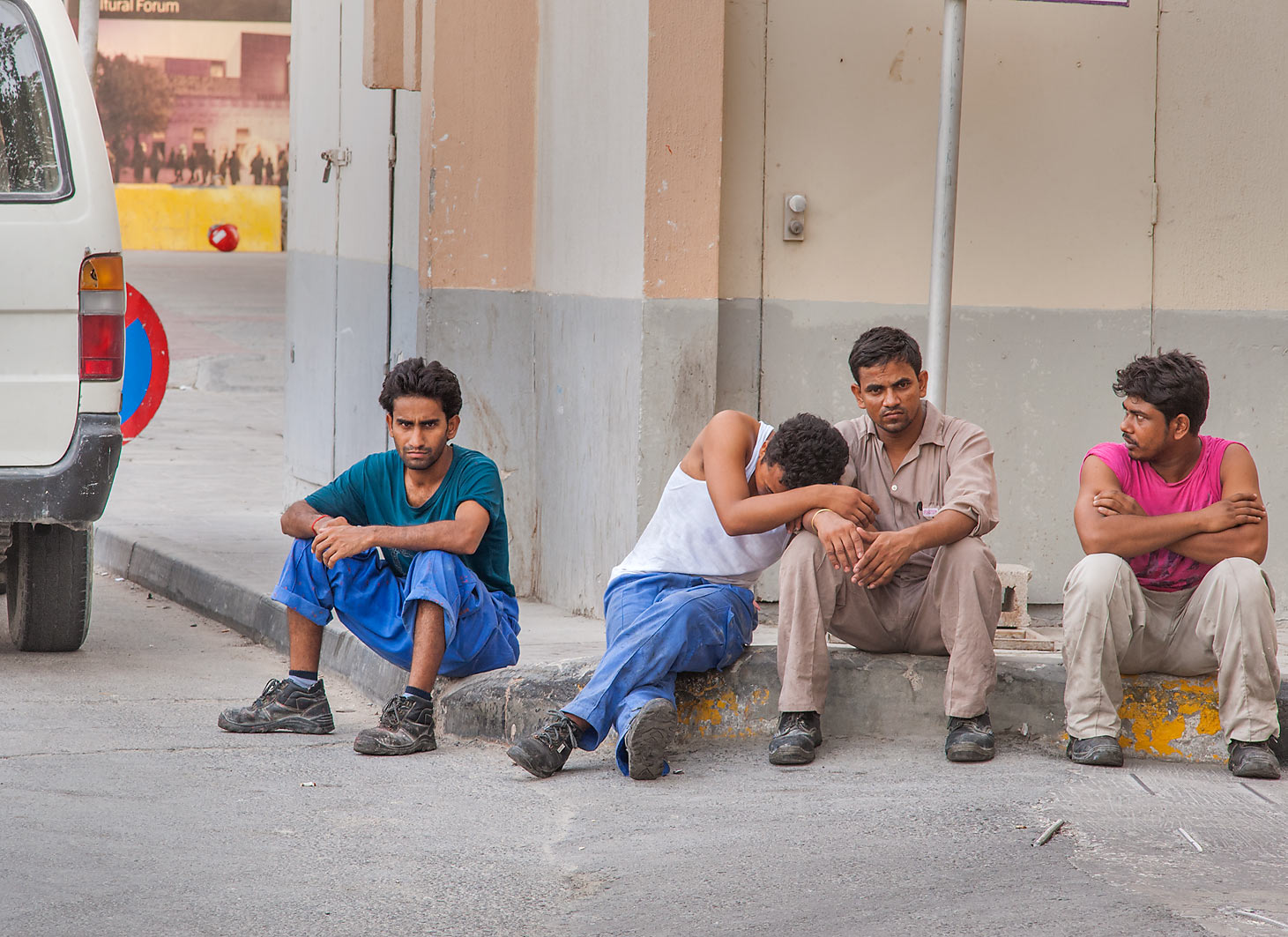
At 6:00 a.m. on a Friday—typically the sole day of rest—four laborers rest on a curb in a state of profound, paralyzing exhaustion. Rather than enjoying leisure time, they appear stranded on the pavement with blank, weary stares. During this period of redevelopment, companies and landlords frequently executed sudden evictions to clear tenements for modernization projects. Clad in casual t-shirts and tank tops, these men appear not as participants in the city's wealth, but as discarded collateral, forced to sleep on the street until new accommodations could be secured.

Chapter III

The Respite of Al Ghanim

For the vast expatriate workforce building pre-World Cup Doha, Friday represented the sole day of rest. Isolated in distant labor camps for the majority of the week, the men possessed few dedicated public parks or recreational facilities, as many were designated as 'family zones' and off-limits to single laborers. Consequently, thousands descended upon the central transit hub of the Al Ghanim Bus Station. Shedding the mandated blue coveralls and neon hard hats of the construction sites, they arrived in their personal 'Friday best' to reclaim a brief sense of agency. Within these dusty overflow lots, decaying souqs, and sparse traffic islands, the workers forged micro-economies, shared digital lifelines, and built a vibrant, resilient community on the margins of a city they were physically constructing.

The Improvised Park

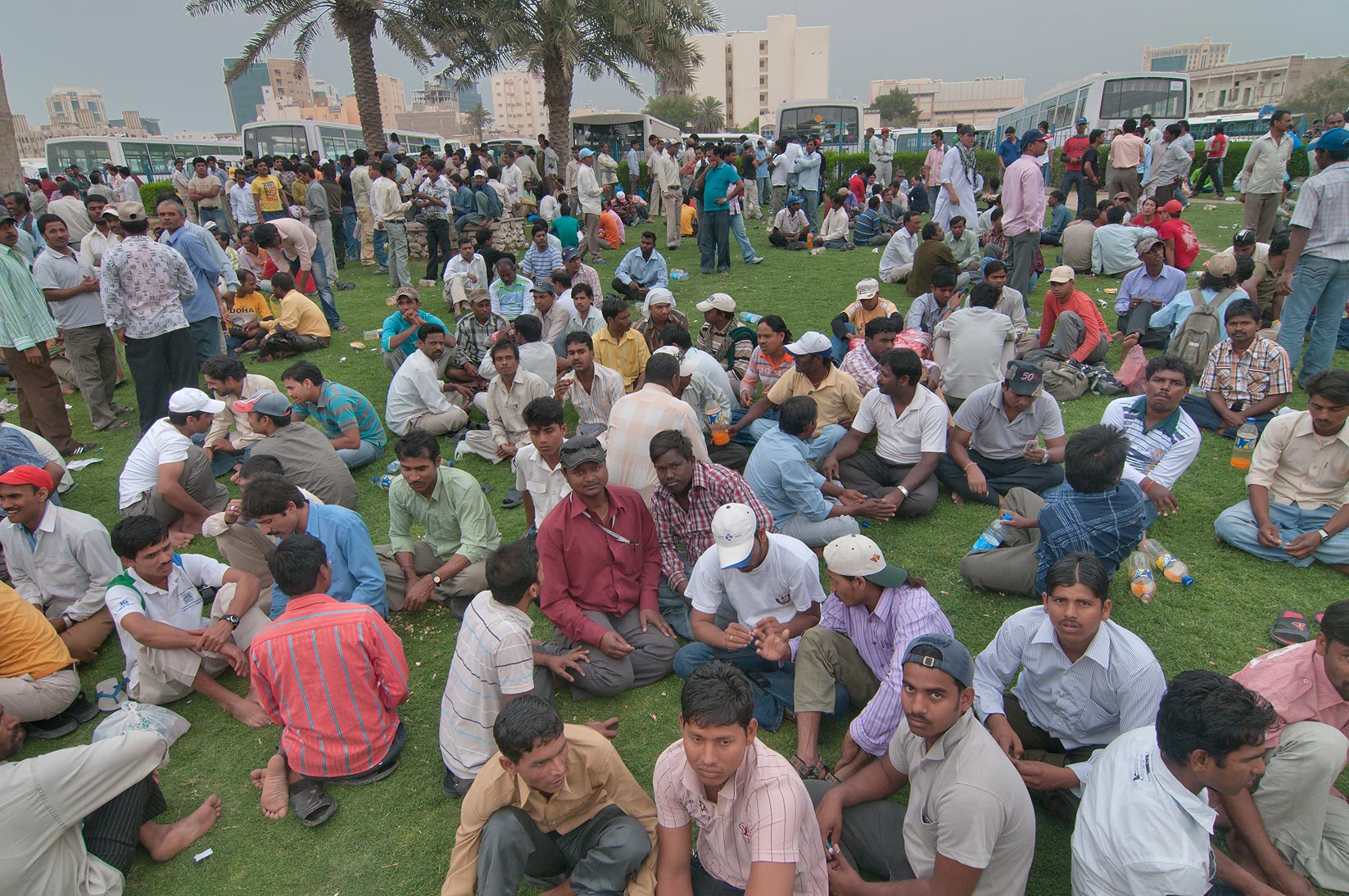
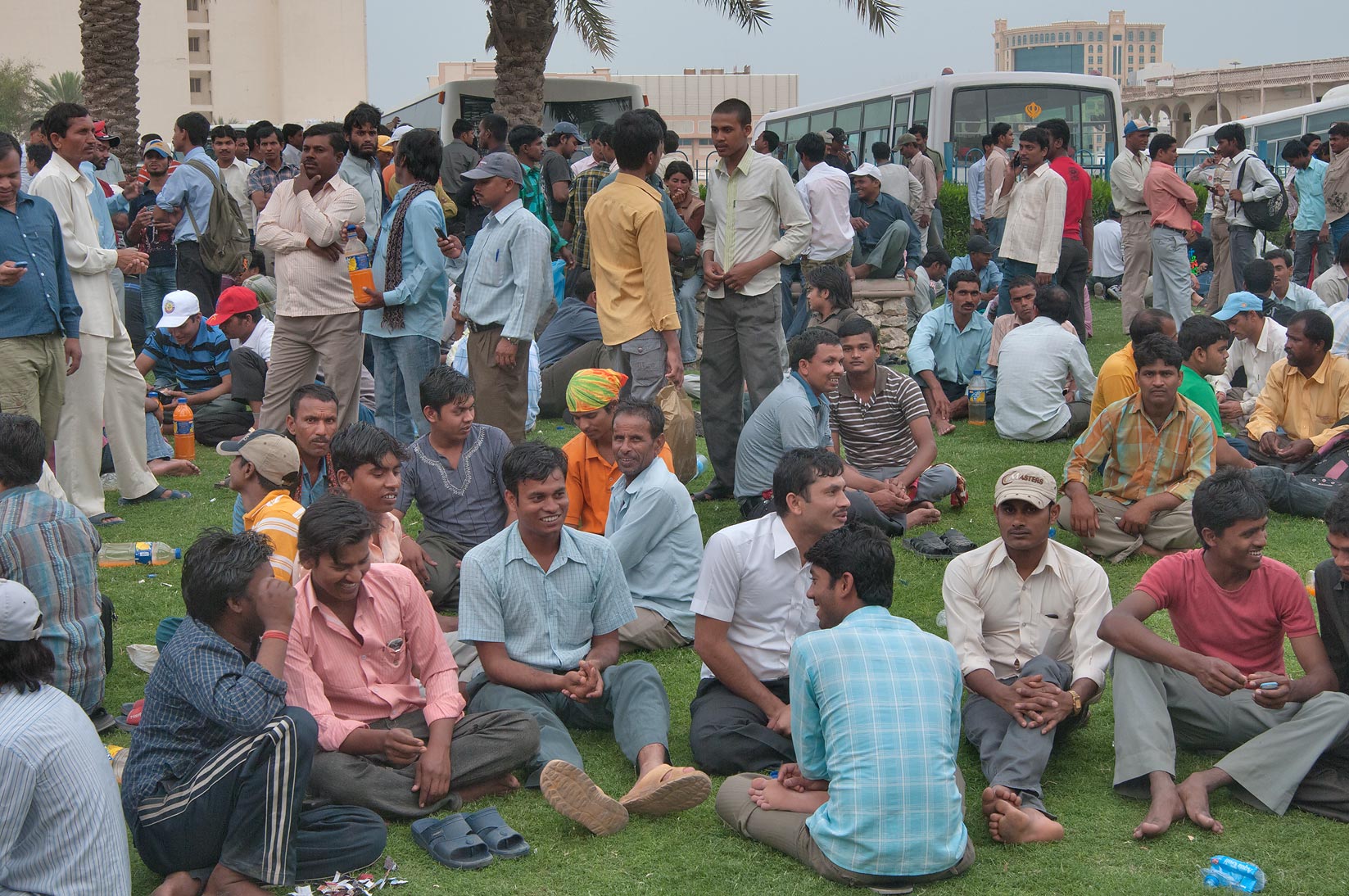
From an elevated vantage point, the sheer volume of the city’s expatriate population becomes visible as hundreds of men blanket a public lawn near the bus station. Packed tightly into dozens of distinct conversational circles, the crowd forms a vivid mosaic of button-down shirts and bright polos against the grass. In the background, a perimeter of pale blue Mowasalat transit buses idles beneath overcast skies, ready to eventually transport the men back to the Industrial Area.

The Dusty Thoroughfare

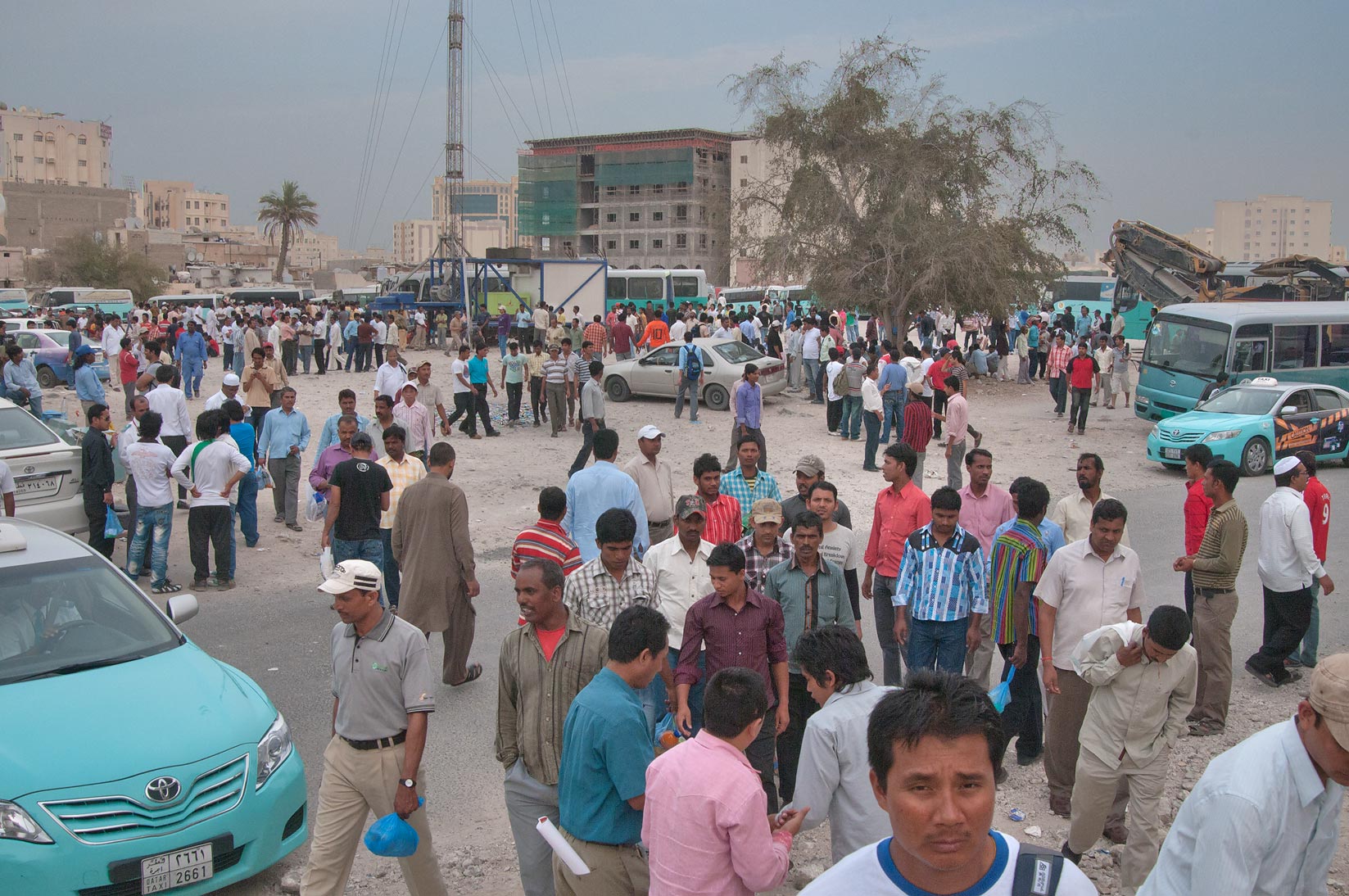
The unpaved expanse beside the bus station functions simultaneously as a chaotic transit hub and an improvised plaza. Bright aqua-colored Karwa taxis thread slowly through the dense crowd of pedestrians navigating the dusty, rocky terrain. Looming in the background is a partially constructed building wrapped in green scaffolding and an industrial crane, providing a stark visual reminder of the skyline these men spend the rest of their week building.

Friday Camaraderie

Despite the restrictive realities of their employment, the Friday gatherings provide a space for genuine joy and camaraderie. In the foreground, the mood is noticeably cheerful; one man in a pink striped shirt laughs openly while chatting, and another in a light blue patterned shirt sits comfortably with bare feet, fully relaxed. Scattered around them are plastic sandals and water bottles, indicating they have settled in to make the most of their few hours of leisure.

The Group Portrait

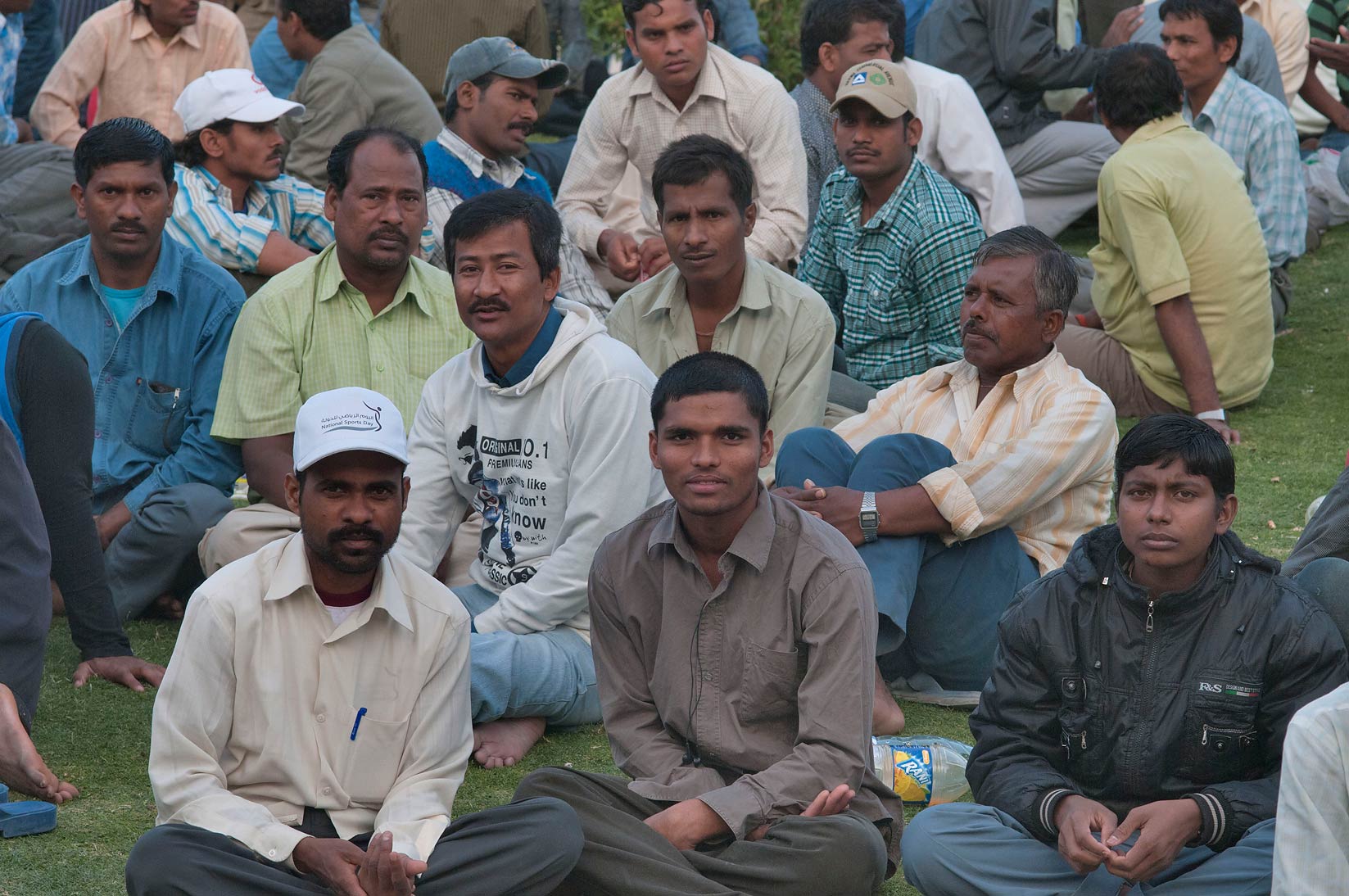
A tightly packed group of workers poses for a rare, composed portrait on the lawn. Their personal attire—from polo shirts to a 'National Sports Day' baseball cap—reflects their individuality, a sharp visual contrast to the anonymous uniformity required of them during the week. Their expressions range from gentle, accommodating smiles to looks of deep, quiet weariness, freezing a moment of dignity amid the relentless demands of their labor.

Three Men with the Mobile Phone

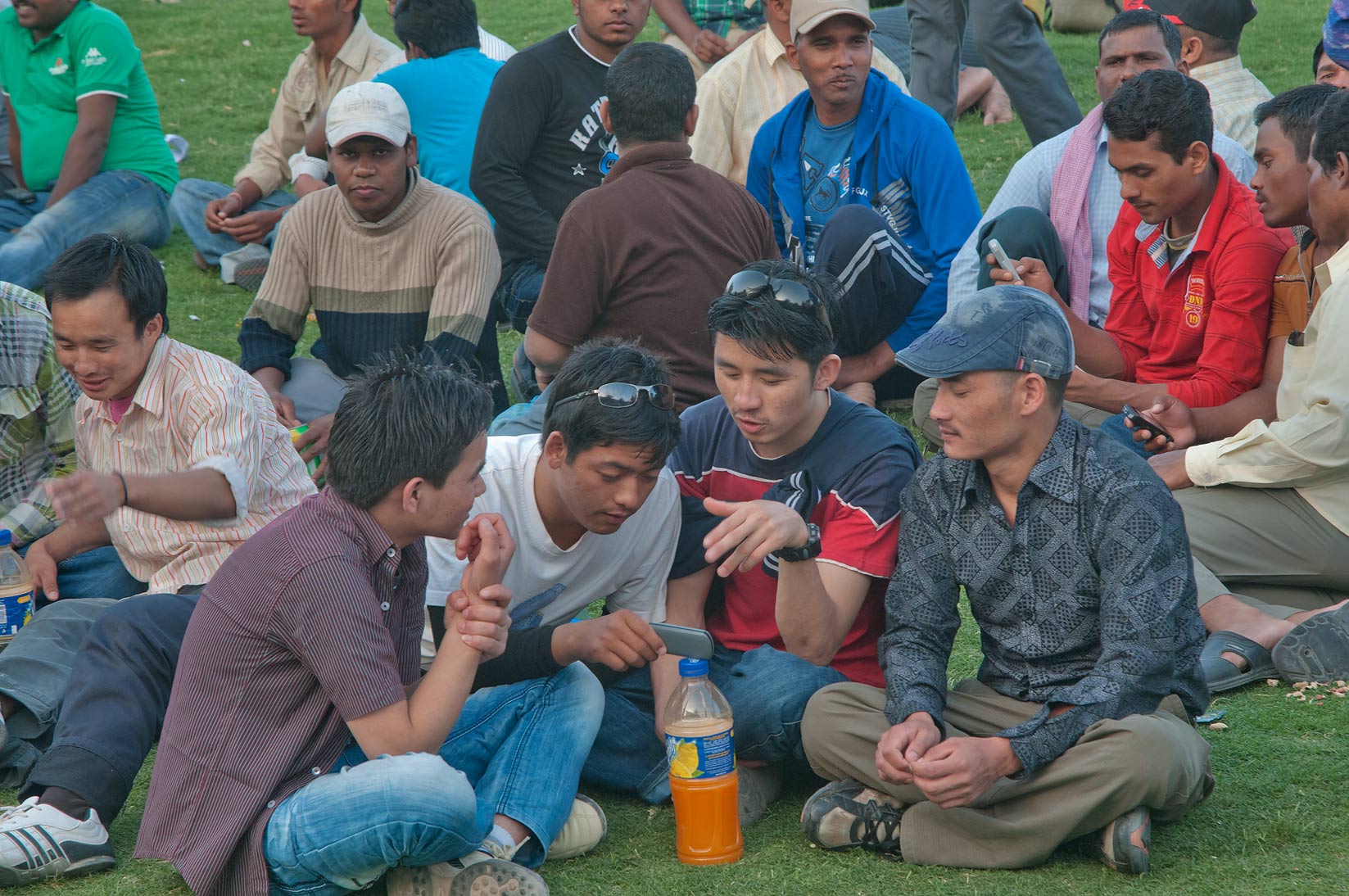
Three young men sit cross-legged on the grass, their shared attention fixed entirely on a mobile phone screen. One man carefully angles the display so his companions can see, resting a large plastic bottle of orange soda on the grass before him. The tight crop of the image emphasizes the intimacy of this shared digital experience against the massive, sprawling crowd directly behind them.

 The Animated Conversation

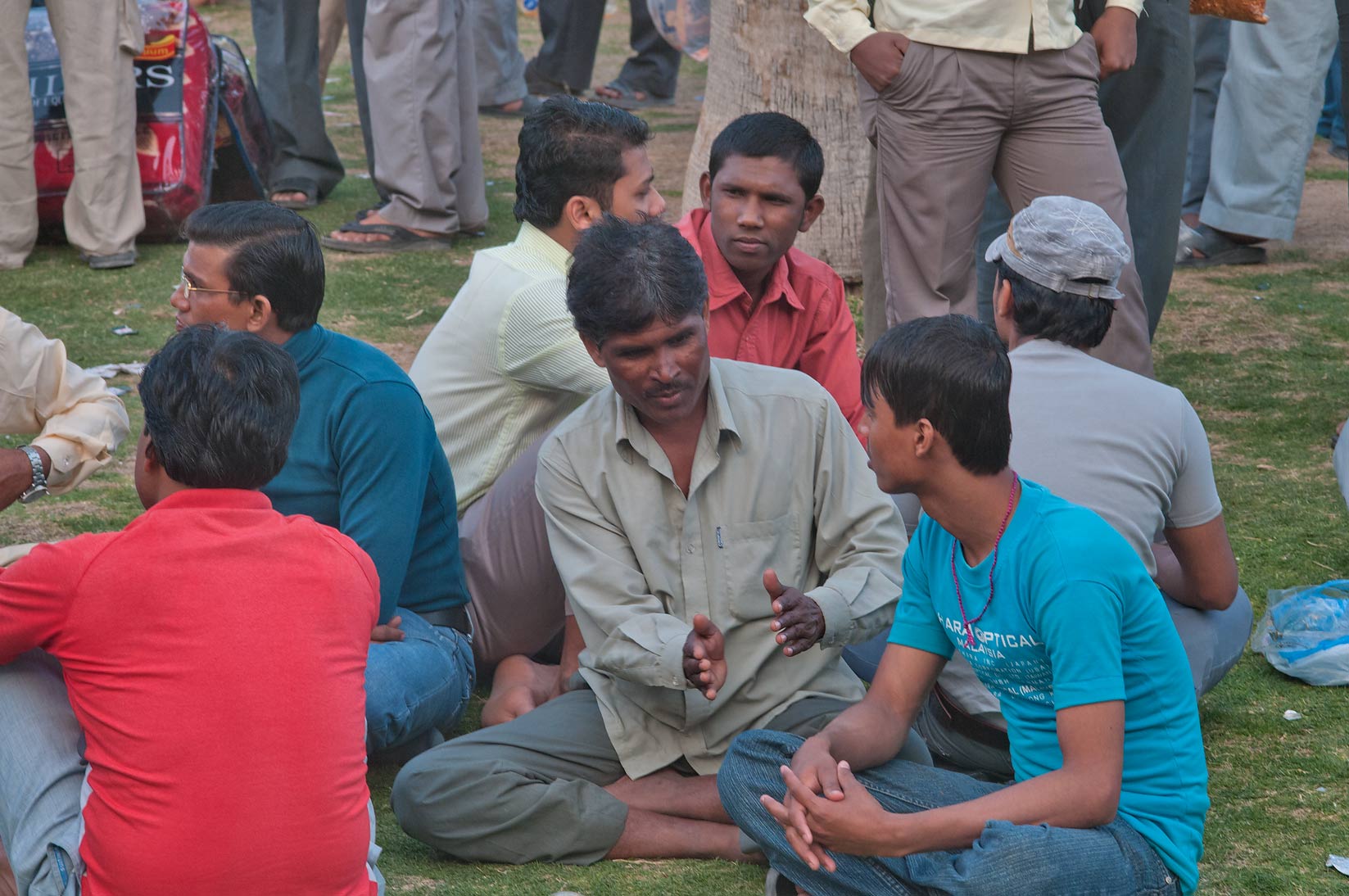
A man in a green button-down shirt leans forward, gesturing expressively with both hands as he leads an animated discussion with his companions. The framing highlights the severe lack of available space; behind the main subjects stands a solid, cramped wall of other workers' legs and torsos. Despite the lack of benches or shade, these impromptu forums served as vital spaces to exchange information and seek advice.

The Al Najada Souq

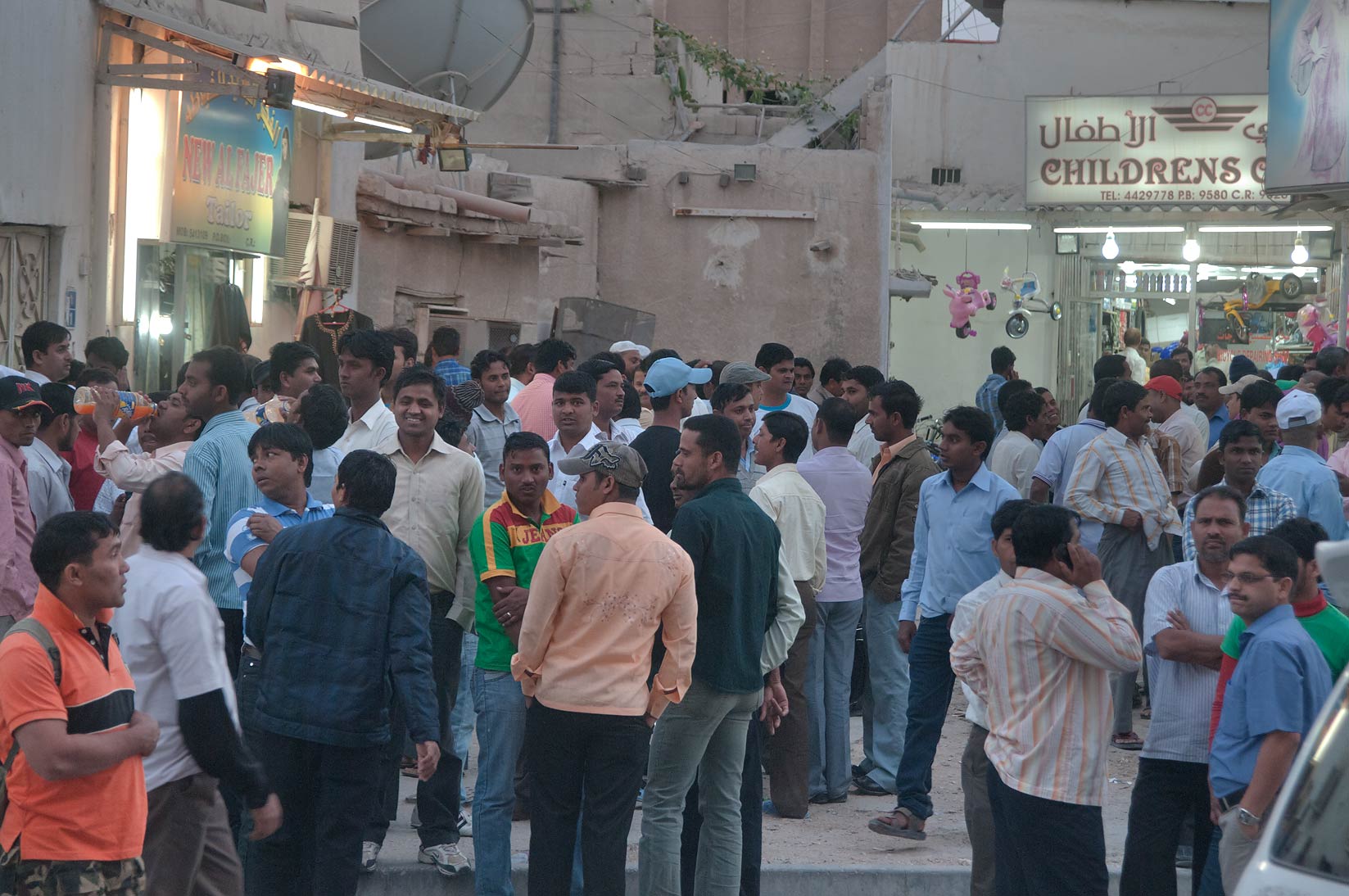
The narrow streets of the historic Al Najada Souq transform into a kinetic hub of expatriate social life. Set against weathered plaster walls, exposed wiring, and traditional storefronts like the 'New Al Fajer Tailor,' the scene grounds the workers in older, organic urban spaces. Here, drinking bright bottles of orange Mirinda, they navigate a gritty environment that stands in sharp contrast to the hyper-modern luxury towers they spend their weeks constructing.

The Improvised Flea Market

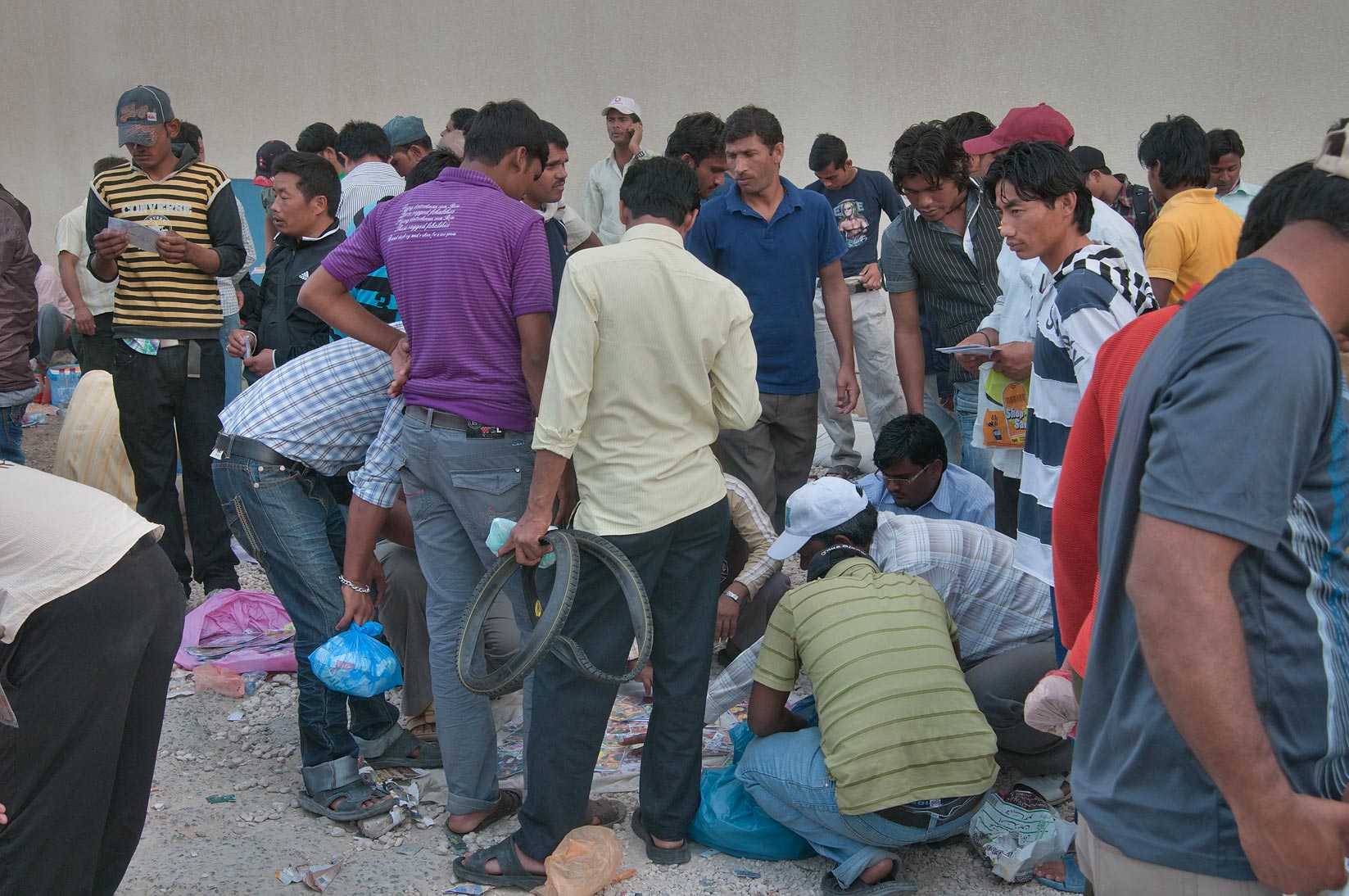
A dusty, unpaved lot near the station is converted into an informal Friday flea market catering to the tight budgets of the laborers. Workers crouch to inspect goods laid out on flattened cardboard, while one man in the foreground holds two black bicycle tires for trade. Set against a plain concrete wall littered with plastic bags and debris, the market highlights a resourceful micro-economy operating entirely without municipal infrastructure.

The Transit Hub

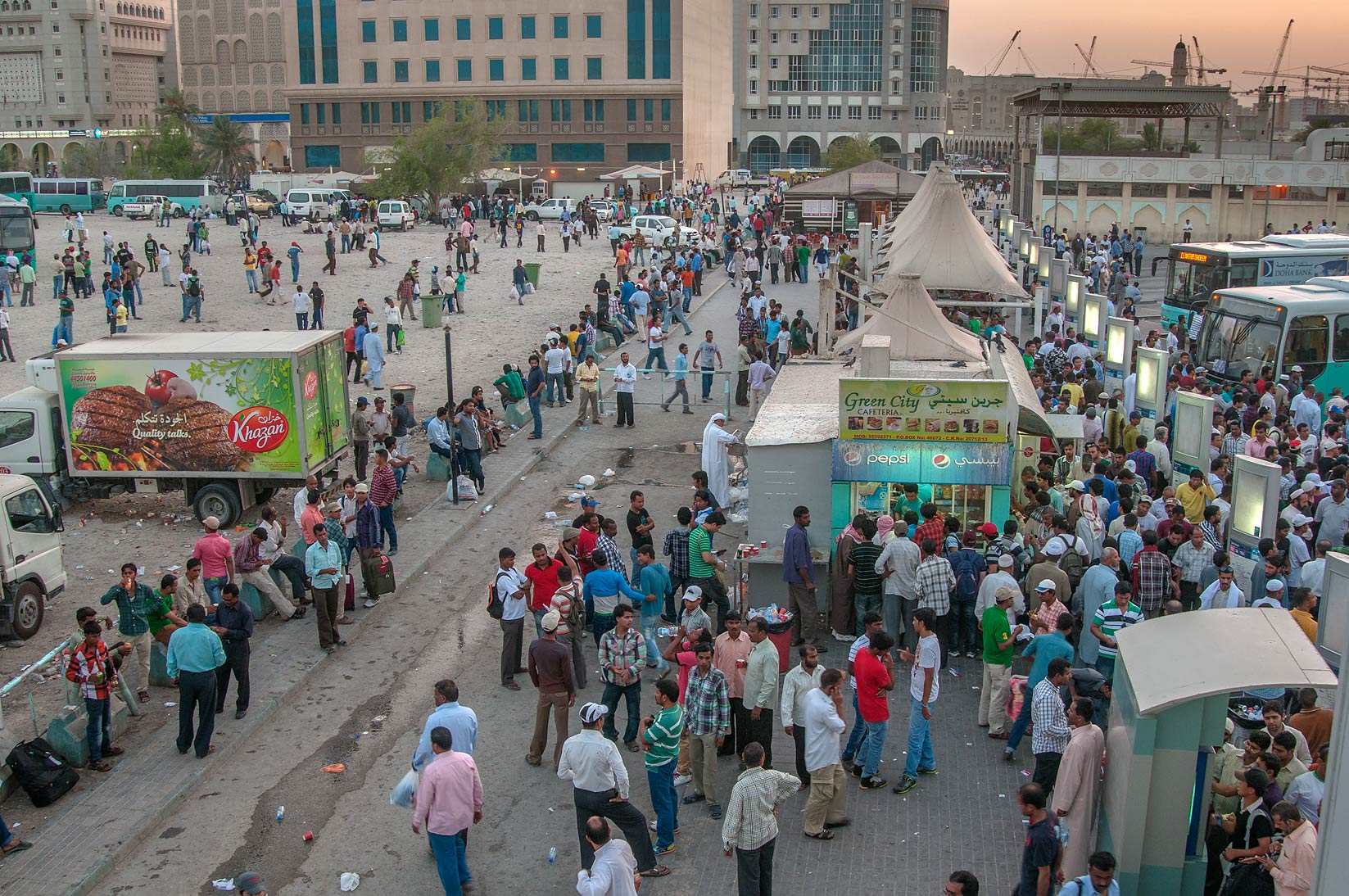
The visual contrast at the Al Ghanim depot reveals the logistical reality of the workforce. On the right, men queue in tightly marked lanes under small tents, waiting to board the Karwa buses that will shuttle them back to the Industrial Area. To the left, the crowd spills out into a large, dusty, unpaved lot where food delivery trucks like the prominently parked 'Khazan' vehicle serve the endless stream of commuters.